


But here's what most companies won't tell you: every feature added is a promise made—about setup time, complexity, and what users need to maintain. For Viztalab, a telescope designed for effortless stargazing, we asked a different question: "What can we intentionally leave out, so the experience feels lighter and more immediately rewarding?"
The Hidden Cost of Every Feature
Beyond the obvious costs (weight, size, price), features carry hidden burdens:
- Cognitive load - More to understand, configure, and troubleshoot
- Setup time - More assembly, calibration, and initialization
- Decision paralysis - More options can reduce satisfaction
- Delayed gratification - Complexity postpones the moment of wonder
That last point is critical. For beginners, the window between "I want to try this" and "I'm giving up" is remarkably narrow. Every minute spent on setup is a minute not spent experiencing wonder.
Why We Didn't Build In Motorized Tracking
This was our most scrutinized decision. Motorized tracking is genuinely useful—it keeps objects centered as Earth rotates and enables long-exposure astrophotography for faint deep-sky objects. So why leave it out?
The Trade-offs Are Significant
Setup: Polar alignment, balancing, cable management
Power: Battery charging, runtime management
Complexity: Multiple tracking modes, troubleshooting drift
The Core Question: What's the Primary Use Case?
For Viztalab, we defined our promise clearly: "Your first meaningful astronomical photo in under five minutes." For beginners who want to capture:
- The Moon's craters and phases
- Bright planets (Jupiter's moons, Saturn's rings)
- Wide star fields and constellations
Tracking isn't necessary.
The Math of Short Exposures
Here's what most beginners don't realize: you can capture excellent images without tracking. The "500 Rule": Maximum exposure time ≈ 500 / focal length before star trailing appears.
For Viztalab (~300mm equivalent):
- Practical exposure: 1-2 seconds before trailing
- With smartphone image stacking: combine multiple exposures for excellent results
This captures:
- Lunar surface detail
- Jupiter's cloud bands and moons
- Saturn's rings
- Bright star clusters
- Constellation patterns
What it doesn't capture: Extremely faint deep-sky objects like distant galaxies—targets that interest users typically 6-12 months into the hobby, not on day one.
The Alternative: Intelligent Stacking
Instead of tracking, Viztalab uses intelligent image stacking:
- Captures multiple short exposures
- Accumulates signal across frames
- Averages out noise
- No tracking required
- Produces excellent results for bright to moderate objects
Users get compelling images without the setup, weight, and learning curve of motorized tracking.
Keeping the Telescope Purely Optical
Viztalab contains zero electronics. No motors, sensors, microcontrollers, or battery. Why?
Electronic components create ongoing friction that discourages use:
- "Forgot to charge it before the clear night"
- "Battery doesn't hold charge anymore"
- "Firmware needs updating"
- "Motors making strange noise"
- "Bluetooth won't pair"
Each issue creates friction between wanting to observe and actually observing.
The Philosophy of Separation
Instead of embedding intelligence into the telescope:
The telescope does optics. Your smartphone does intelligence.
Your phone already has:
- Powerful processor
- High-quality camera
- Sophisticated software
- Battery management you understand
- Regular updates
Why duplicate these inside the telescope? That adds weight, cost, and maintenance for functionality you already carry.
Additional benefits:
Future-proofing: As smartphone cameras improve, Viztalab automatically benefits. The optics remain excellent; the "brain" gets upgraded with your phone.
Durability: Fewer components = fewer failure points. No firmware bugs, dead batteries, or electronic failures. The glass and aluminum perform identically in 10 years.
Instant readiness: No charging, booting, or calibration. Ready when you are.
Environmental: No lithium batteries to dispose of, no electronic waste when components fail.
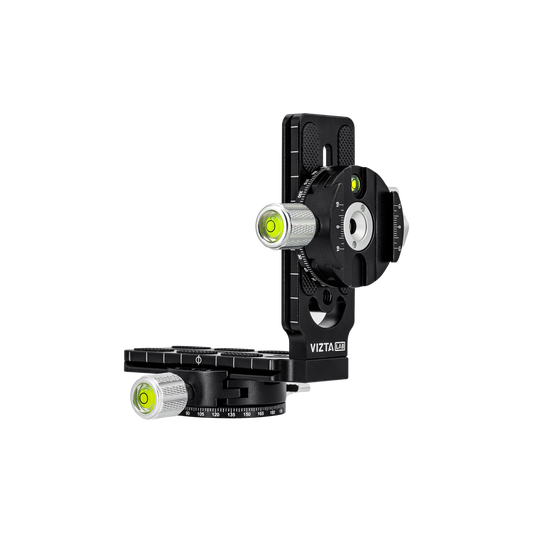
The Optional Equatorial Mount
For users who eventually want longer exposures and fainter objects, we offer an optional equatorial mount designed for Viztalab.
Key principle: It's an addition, not a requirement. Viztalab delivers a complete experience without it. The mount becomes relevant when users understand whether they want to pursue advanced astrophotography.
Why this works:
- Lower barrier to entry for new users
- Informed decisions based on real experience
- Modular investment (don't pay for unused features)
- Base telescope remains ultraportable
The Friction Audit
During design, we identified every friction point that could discourage use:
| Friction Point | Our Solution |
|---|---|
| Remembering to charge device | No electronics to charge |
| Setting up tracking | No built-in tracking (excellent results without it) |
| Managing multiple software/cables | Single integrated app, no cables |
| Carrying multiple components | Everything fits in small bag |
| Needing dark skies | Optimized for bright objects visible from cities |
Each removed friction point increased the likelihood of actual use.
The Real Capability: Frequency
This loop is more powerful than any single technical feature.
Designed With Intention
We didn't remove features to cut costs. These decisions made development harder:
- Precision optics in minimal weight requires advanced engineering
- Image processing without tracking required sophisticated algorithms
- Maintaining stability without heavy housings demanded careful materials
We removed features to create clarity of purpose. Every decision supported one experience: unburdened stargazing.
A telescope you can:
- Carry effortlessly
- Set up instantly
- Use without worrying about charge, alignment, or configuration
Less, So You Can See More
What we chose not to add defines Viztalab as much as what we included.
Because sometimes, removing complexity isn't about doing less—it's about making space for the experience itself.
We didn't aim to build everything.
We aimed to build exactly the right thing for effortless, joyful stargazing.
Experience astronomy designed around you, not around specifications. Discover how Viztalab's intentional simplicity creates freedom to explore the sky.